Case Study — Cemetery & Memorial Services
$3,149 In Ad Spend to $225,000 In Sales: How Meta Ads Sold Crypts for an Australian Cemetery
A well-established Australian cemetery had crypts for sale — a high-value, emotionally significant purchase with a long sales cycle. Orbit Marketing built a three-phase Meta ads campaign that turned $3,149 in ad spend into $225,000 in crypt sales — a 71× return on ad spend, with more sales still being followed up.
Not every client wants their business named alongside a campaign like this one. We respect that, so this case study describes the strategy and results without identifying the cemetery.
$3,149 |
$225K |
71× |
|
Ad Spend
|
Revenue Generated
|
Ad spend, revenue generated, and return on ad spend for the campaign.
The Challenge
Facebook and Instagram advertising is usually associated with e-commerce stores, gyms or local tradies — there's a common misconception that Meta ads generate poor-quality leads and don't work for high-value products or services.
This client had a real commercial challenge: crypts available for sale, a high-value product with a long sales cycle, and a market that required careful, respectful communication. Crypts aren't an impulse purchase — they're a significant financial and emotional decision, often made by people planning ahead for themselves or a loved one.
The brief was straightforward: generate qualified enquiries from people interested in purchasing a crypt, so those enquiries could actually convert into sales — not just pad out a list. The budget was modest. The expectations were conservative. The results were not.
The Strategy
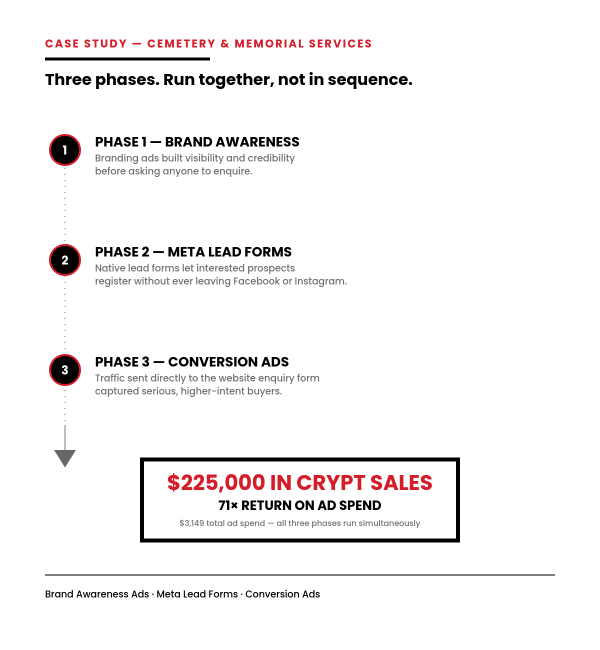
Orbit built a three-phase Meta ads approach across Facebook and Instagram, designed to meet potential buyers wherever they were in their decision-making process. With a tight timeframe and a modest budget, all three phases ran virtually simultaneously — rather than launching one after another — so no momentum was lost and every dollar of spend was maximised.
Before building anything, the team identified three ideas that mattered most to the audience: spirituality (the emotional weight behind the decision), the quality of the physical product (marble, brass, craftsmanship), and having a place to come, sit, reflect and remember. These three ideas shaped every piece of copy and creative.
-
Brand Awareness — Making Them Known Locally
Branding-focused ads built visibility and credibility, and gently introduced the idea of crypt ownership to an audience that may never have considered it before. These ads weren't selling — they were warming.
-
Meta Lead Form Ads — Reducing Friction
Native, high-intent lead forms let interested prospects register without ever leaving Facebook or Instagram — no website to load, no form to build from scratch. Lower friction meant more people willing to raise their hand.
-
Conversion Ads — Capturing Serious Buyers
Conversion-focused ads sent higher-intent traffic directly to the website enquiry form, capturing buyers further along in their decision-making process who were likely to convert quickly.
Three phases, run in parallel rather than in sequence, feeding into one result.
The Results
On a total ad spend of $3,149, the campaign generated $225,000 in crypt sales — a return on ad spend of more than 71 times the investment. That figure will almost certainly climb further, as there are still active leads being followed up by the client's sales team.
Beyond the numbers, this campaign proved something Orbit Marketing believes deeply: no industry is too difficult, too sensitive, or too niche for a well-built, planned and executed Meta ads strategy.
What Made It Work
Respecting the audienceThe creative and copy acknowledged the emotional weight of the decision without being morbid or clinical, speaking to people at every stage of the decision-making process. |
Testing, measuring and staying vigilantThe team monitored results closely, ran multiple versions of copy and creative, and directed more budget toward whichever messaging was resonating most strongly. |
Building a system, not just an adAwareness, lead gen and conversion ads running together meant reaching people at every stage of readiness, not just those already primed to buy. |
Giving the sales team quality leadsSeparating lead form responses from website conversions let the client's sales team see which leads were warm and which were hot, and follow up accordingly. |
Keeping spend tight and targeting sharp$3,149 isn't a big budget. Precise audience targeting and ongoing optimisation meant spend wasn't wasted on people who would never buy. |
testimonial
I worked with Simon, Jo and the Orbit Marketing team over the last six months and they were a trusted partner in planning and delivering our digital marketing campaigns to drive visibility and leads. They brought strong strategic thinking, a solid understanding of how channels work together, and a data-driven approach to optimising performance and ROI. The team was always responsive, reliable and a pleasure to work with, providing great value. If you're looking to extend your marketing capability with an experienced partner, I'd highly recommend Orbit Marketing and would gladly work with them again.
Katrina Colpo
Marketing and Engagement Manager.
Frequently Asked Questions
What return on ad spend did the cemetery get from Meta ads?
What advertising channels did Orbit Marketing use for this campaign?
Three Meta ad types run across Facebook and Instagram: brand awareness ads to build visibility and trust, native lead form ads to capture interest with minimal friction, and conversion ads sending high-intent traffic directly to the website enquiry form.
Why were the three ad phases run at the same time instead of one after another?
With a tight timeframe and modest budget, running brand awareness, lead form and conversion ads simultaneously meant no momentum was lost and every dollar of spend was maximised, while still reaching buyers at every stage of readiness.
Are Meta ads effective for sensitive or high-value purchases like crypts?
Yes. This case study shows Meta ads can work for considered, emotionally significant purchases with long sales cycles, not just e-commerce — provided the strategy, creative and targeting respect the seriousness of the decision.
The Takeaway
If a cemetery can generate a 71× (and climbing) return on ad spend selling crypts on Facebook and Instagram, what could the right Meta ads strategy do for your business? The answer isn't boosting a few posts and hoping — it's a strategy built around your specific product, your specific buyer, and a system that moves them from stranger to enquiry to sale.